“If children aren't using their imaginations, they're not doing childhood right.”
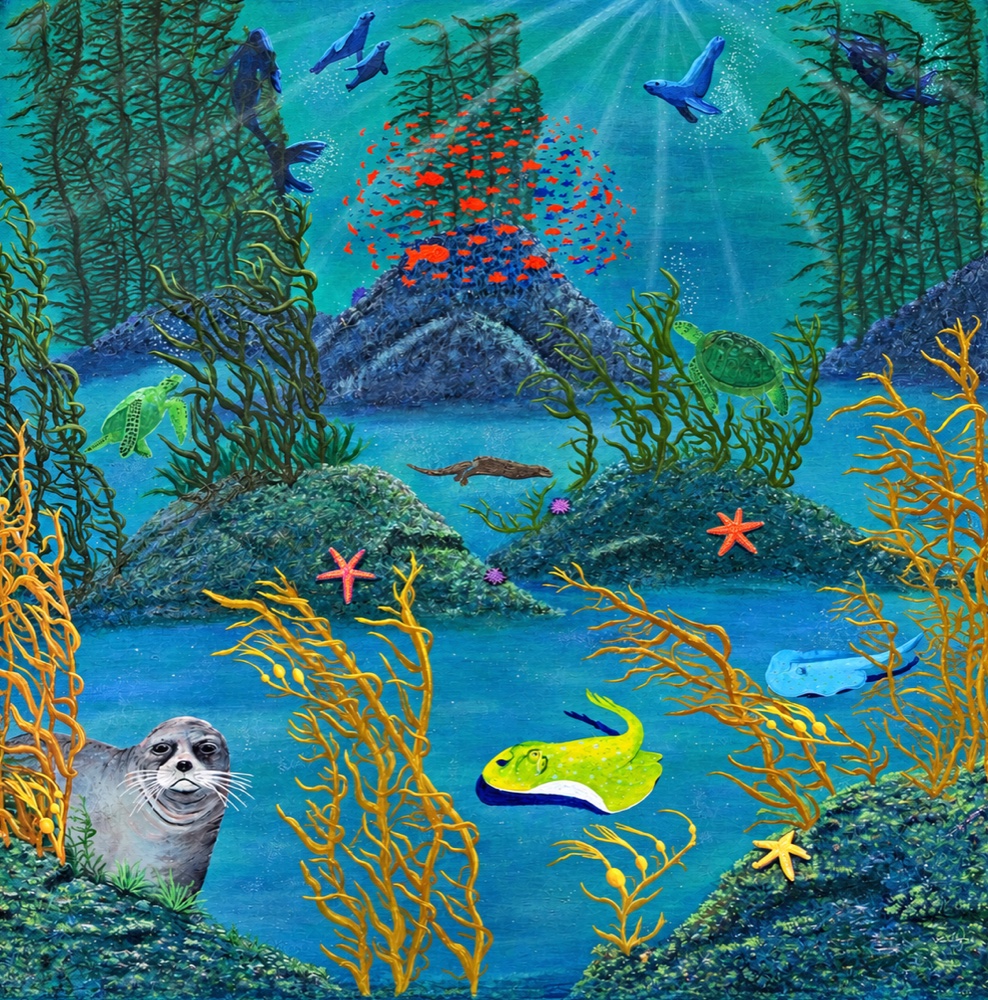
Under the Sea was originally created for the children’s area of a library in Valencia, California. The project had a particularly personal meaning for me. When I first arrived in the United States from Argentina as a child, I learned English largely through reading, so libraries and books became an important part of my experience of finding my way into a new culture and language. Years later, I found myself creating an imaginative world for children through a painting commissioned for a library.
The project was an open call in which artists were invited to submit sketches, and five artists were ultimately selected to bring their designs to life. I was honored to be one of those five artists.
I was asked to create an underwater environment featuring kelp and/or coral. I originally intended to concentrate primarily on kelp, but as the painting developed, the landscape evolved to include several large, textured coral formations as well. I created the coral texture using scented bath salts, transforming an ordinary manufactured material into a surface suggesting the rough, irregular structure of a living reef. This material choice also introduced a quieter environmental message: the substances and materials humans create and use can ultimately become part of the environments in which marine life must survive.
I wanted the painting to be both educational and rewarding to the imagination. The marine animals depicted are all species associated with kelp-forest ecosystems, grounding the underwater world in a real environment rather than an invented collection of sea creatures. The mermaids are the exception, and they are deliberately hidden within the kelp. Some inhabitants are immediately visible, while others reveal themselves only when the viewer looks more closely.
In my original proposal to the library, I wrote that if children aren't using their imaginations, they're not doing childhood right. I wanted to give children a reason to look twice: to learn about a real marine ecosystem, discover its inhabitants, and then be rewarded with something that exists only in their imagination.
For me, the painting exists on two levels: a joyful underwater world that invites children to explore, learn, and imagine, and a quieter reminder that the extraordinary environments depicted in it are real, fragile, and worth protecting.